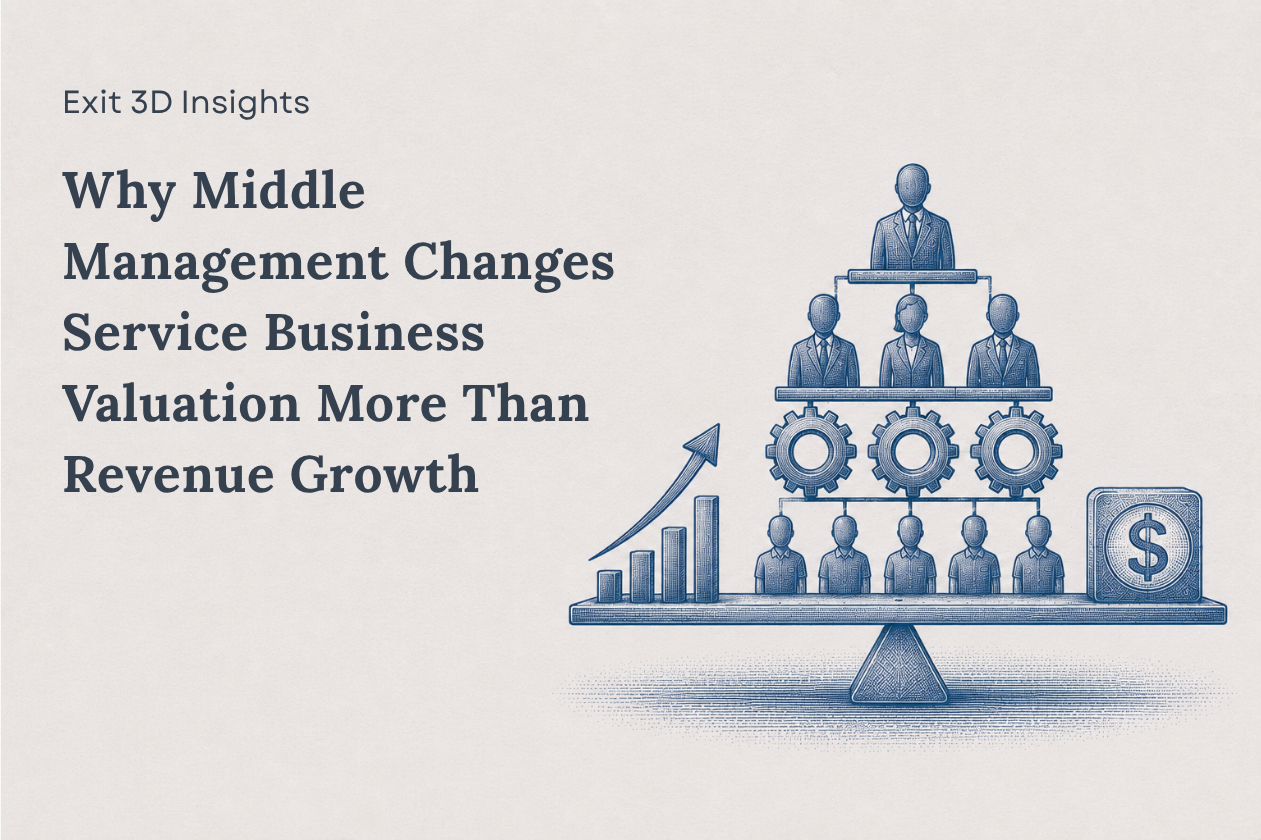
A service business generating $2.1M in EBITDA recently sold at 2.8× — roughly half what the founder expected. Revenue had grown 22% year over year. The business had strong client retention and clean contracts. What killed the multiple was a single question the buyer asked during diligence: Who runs this when you're not here? There was no good answer.
Buyers don't price what a business earns. They price what a business can sustain after ownership changes hands. Those are two different calculations, and founders who conflate them routinely leave 30–50% of deal value on the table.
Middle management is one of the clearest signals buyers use to distinguish between the two. It tells them whether the business is an asset or a dependency.
This post breaks down exactly how that signal works, where it shows up in diligence, and what it costs you when it's absent.
A strong EBITDA number does not offset weak management depth. Buyers ask who makes decisions when the founder is absent — and that question is not procedural. It is the core of how they underwrite risk.
When the answer is unclear, buyers don't walk away. They reprice. The multiple compresses, the structure shifts toward earn-outs and seller notes, and the founder carries more post-close risk. A $2M EBITDA business with no middle management layer rarely trades at the same multiple as one with three accountable team leads who can run operations without daily oversight.
Revenue growth earns revenue. Management depth earns multiple.
Buyers are not evaluating your business as it runs today. They are modeling how it performs under new ownership — with a different operator, different incentives, and no institutional memory from the person who built it.
Middle management is the connective tissue between the founder's decisions and the team's execution. When it exists, buyers can model continuity. When it doesn't, they're underwriting a fragile transition where one departure — the founder's — could disrupt everything below it.
Sophisticated buyers run a simple mental model: what breaks first if the seller exits on day one? In most founder-led service firms, the answer is client relationships, delivery quality control, and internal escalations — because the founder handles all three personally.
Middle management fixes that by distributing those functions before the sale. A client success lead who owns retention. An operations manager who runs delivery. A team lead who handles escalations. Each role reduces the blast radius of the founder's exit.
Growing revenue can actually mask the problem. A founder who personally drives sales, manages key accounts, and oversees delivery can grow a business to $3M, $5M, even $8M in revenue — and still have zero management infrastructure beneath them.
Buyers see that pattern clearly in diligence. High revenue with thin management is not a growth story — it is a concentration risk with a good income statement.
Middle management is a transferability signal. It shows the business can execute without daily founder intervention — and transferability is the core question buyers are paid to answer before they commit capital.
When a firm has accountable managers in place, buyers can stress-test the transition. They can model what happens when the founder moves to an advisory role, steps back from client delivery, or exits the business entirely within 12 months. Each scenario becomes more plausible — and more fundable — when leadership is distributed.
A business that can execute without its founder is a business a buyer can confidently own.
Diligence is designed to surface risk the income statement doesn't show. Thin leadership is one of the first structural risks buyers look for — and it shows up in specific, predictable ways.
Buyers ask for an organizational chart early. They are not looking at titles. They are looking at reporting lines, decision authority, and whether any named person below the founder has real operational accountability — or whether everyone escalates upward.
A flat org chart where all roads lead to the founder is not a sign of efficiency. It is a signal that the business has never developed the infrastructure to survive without its builder.
Buyers frequently call key employees and clients as part of late-stage diligence. When every question about process, decisions, or client management routes back to the founder — he handles that, she approves those, you'd need to ask him — it confirms the structural dependency that the org chart suggested.
That pattern is not anecdotal. Buyers treat it as confirmation that key-man risk is real and unmitigated.
Some buyers ask a direct question during management presentations: what happens when the founder is on vacation for two weeks? The founders who answer well describe a specific person with a specific role. The founders who struggle describe a team that pauses, escalates, or waits.
That answer changes how the deal gets structured more than almost any financial disclosure will.
Thin leadership creates hidden key-man risk. That risk is often priced into the multiple before the seller notices it — meaning the discount is already baked into the first LOI before any negotiation begins.
Buyers do not announce this explicitly. They adjust the multiple, require longer transition periods, or push for earn-out structures that tie payout to post-close retention. Each mechanism transfers risk back to the seller. The seller often accepts it without understanding the structural reason it was proposed.
By the time you see the discount in an LOI, it has already been decided.
The financial impact of thin management is real, measurable, and often larger than founders expect. It shows up in three specific places: the multiple, the deal structure, and the financing terms.
Service businesses with strong management depth typically trade at 4–6× EBITDA in the current market. Founder-dependent businesses with comparable revenue and margin often trade at 2–3×. That gap is not driven by revenue quality alone. It is driven by how much execution risk the buyer is absorbing on day one.
On a $2M EBITDA business, the difference between a 3× and a 5× multiple is $4M in proceeds. That delta is not theoretical — it is the direct cost of not building a management layer before going to market.
When buyers can't underwrite management continuity, they shift risk back to the seller through deal structure. Earn-outs extend the seller's financial exposure 12–36 months post-close. Seller notes require the seller to carry a portion of the purchase price with performance contingencies attached. Longer transition commitments tie the founder to the business longer than they planned.
Every one of those mechanisms is, in part, a hedge against the management gap the buyer identified in diligence.
SBA lenders and private equity sponsors both scrutinize management depth during underwriting. A business where the founder is the sole decision-maker is harder to finance — which reduces the buyer pool and often caps the achievable price.
A business built around one operator may look efficient. Decisions move fast. There's no management overhead. Margins can appear strong because the founder absorbs functions that would otherwise be paid roles.
In diligence, that structure can look fragile. The speed and margin that made it feel lean also make it brittle — because they depend entirely on one person remaining present, motivated, and healthy through a transition that is designed to end their role.
Lean is only a feature when the business can stay lean without the founder.
Transferability is not a soft concept. It is a specific financial question: can this business keep producing after the seller steps away? Buyers underwrite that question with the same rigor they apply to contract terms and cash flow.
Middle management is one of the clearest pieces of evidence that the answer is yes. It proves the business has distribution of function — that client delivery, team management, and operational decisions don't collapse the moment the founder is no longer available.
Buyers look for three things when evaluating whether management depth is real: named individuals with clear accountability, evidence those individuals make decisions independently, and a track record of the business operating without constant founder intervention.
A management title on an org chart means nothing if that person escalates every decision upward. Buyers verify through reference calls, interview sessions, and operational questions designed to reveal whether the independence is real or performative.
Lenders who back acquisitions — particularly SBA lenders and PE-backed strategics — require evidence that a competent operator can run the business after close. Middle management is part of that evidence. Management layers make growth more financeable because lenders and buyers need proof that execution is not personality-dependent.
When that proof exists, more buyers can finance the deal, competition for the business increases, and the seller retains more negotiating leverage.
Replacing founder control with accountable managers improves continuity. That continuity is what buyers underwrite — not the founder's track record, not the revenue trajectory, and not the client relationships the founder personally maintains.
Buyers are buying a system. If the system's primary component is a person who is leaving, the system is not what they thought it was. Accountable managers are evidence that the system exists independently of the individual who built it.
Continuity is not a soft metric. It is the structural basis for every premium multiple.
Most service firms have a predictable failure point during ownership transitions. It is not revenue. It is not client relationships. It is operational decision-making — the day-to-day judgment calls that keep delivery on track, teams aligned, and clients confident.
When the founder handles those calls personally, the business runs. When the founder steps back, a vacuum opens. Buyers see that vacuum in diligence and price it accordingly.
In founder-led service firms, the most senior client relationships almost always live with the founder. That is a structural liability at exit. Buyers model what happens when those relationships need to survive the transition — and when there is no relationship manager below the founder, the answer is uncertain.
Middle management at the client layer means a named account lead who the client already knows, trusts, and communicates with independently. That layer is not built in a quarter. It requires deliberate transfer over 12–24 months.
Delivery quality in most founder-led firms is maintained through the founder's direct involvement — reviewing work, resolving issues, setting the standard. When that involvement ends, quality control becomes implicit and inconsistent.
A delivery operations lead with documented standards and direct accountability closes that gap before a buyer finds it open.
The valuation impact of middle management is rarely linear. A deeper bench can change both the multiple and the structure of the deal — not just what the business is worth, but how the buyer finances it and how much risk the seller retains after close.
A business moving from 2× to 4× EBITDA on the same earnings does not just double the proceeds. It typically changes the deal structure entirely: less reliance on earn-outs, smaller seller notes, shorter transition commitments, and a buyer pool that includes lenders who require operational continuity as a condition of financing.
The multiple is the headline, but structure is where the real difference in proceeds lives.
Building middle management for exit is not about creating an org chart that looks right. It is about transferring real decision authority to specific people with documented accountability — and doing it early enough that the independence is visible before buyers start asking questions.
The first step is a decision audit. Map every recurring decision in the business: client escalations, delivery approvals, hiring calls, vendor negotiations, pricing exceptions. Identify which ones currently require the founder's involvement. Then assign each to a named manager with the authority and expectation to handle it independently.
That audit typically reveals that 60–80% of operational decisions could be delegated immediately. The founder's bottleneck is rarely necessity — it is habit.
Buyers want to see management independence demonstrated over time, not installed for the sale. A manager who has been making independent decisions for 18 months carries far more weight in diligence than one who was promoted six months before the process started.
The timeline matters. If you are 1–3 years from exit, the window to build credible leadership depth is now — not when you engage a banker.
Independent managers are more credible in diligence when their function is documented. That means written decision rights, documented escalation thresholds, and a track record of decisions made — not just authority granted on paper.
A manager with 18 months of documented independent decisions is evidence. A manager with a new title is not.
When a business enters diligence with real management depth — named managers, documented authority, demonstrated independence — the deal changes in specific, measurable ways. Buyers move faster. Lenders underwrite more confidently. Earn-out risk drops. Transition timelines compress.
The seller retains more leverage because fewer structural concessions are needed to make the deal financeable. A buyer who can see exactly who runs the business post-close has less reason to demand the founder stay involved, carry a large note, or tie payout to post-close performance.
Institutionalized management converts risk from the buyer's problem into proof that the business can stand on its own.
By the time a founder engages an investment banker or enters a formal sale process, the structural factors that determine the multiple are largely fixed. Management depth is one of them. It cannot be credibly built in 90 days before a deal closes.
Buyers and lenders both distinguish between infrastructure that was built to run the business and infrastructure that was built to sell the business. The latter does not hold up under diligence. Reference checks, behavioral interviews, and operational questions quickly reveal whether a management layer is functional or staged.
The founders who achieve 4–6× multiples are not consistently the ones with the highest revenue growth. They are the ones who built the structural conditions that drive premium multiples — of which management depth is a primary component — years before the sale.
That means the work of building middle management is, fundamentally, a pre-exit investment. The cost is real: salary, time, and the discomfort of releasing control. The return is priced into the multiple, the deal structure, and the probability that the transaction closes at all.
Businesses that cannot demonstrate credible transferability consistently face longer deal timelines, more complex structures, and buyers who discount early and negotiate hard. Those outcomes are not negotiating failures — they are structural ones.
The management layer you build today is the valuation evidence you produce at exit.
For founders who want to understand how founder dependency gets priced into a deal before it ever reaches the negotiating table, the pattern is consistent and worth studying before you start the process.
Middle management is not an operational preference — it is a valuation input. Buyers use it to underwrite whether a business can survive ownership change, and they price the absence of it into the multiple, the deal structure, and the financing terms before the seller has a chance to respond.
The founder who builds leadership depth before going to market is not being cautious — they are being precise about what buyers actually pay for.
If you stepped away from your business tomorrow, which decisions would stop getting made — and which person in your organization would make them without being asked?
A good answer names a specific person and a specific domain. A weak answer routes back to you, describes a team that would manage, or requires you to stay reachable. That distinction is exactly how buyers assess management depth — and it is the single clearest predictor of whether the deal will trade at a premium or require structural concessions to close.
The business that can answer that question clearly is the business a buyer can confidently finance.

%20(1)%201.webp)

.png)
.png)

.webp)

.svg)
.svg)
.svg)