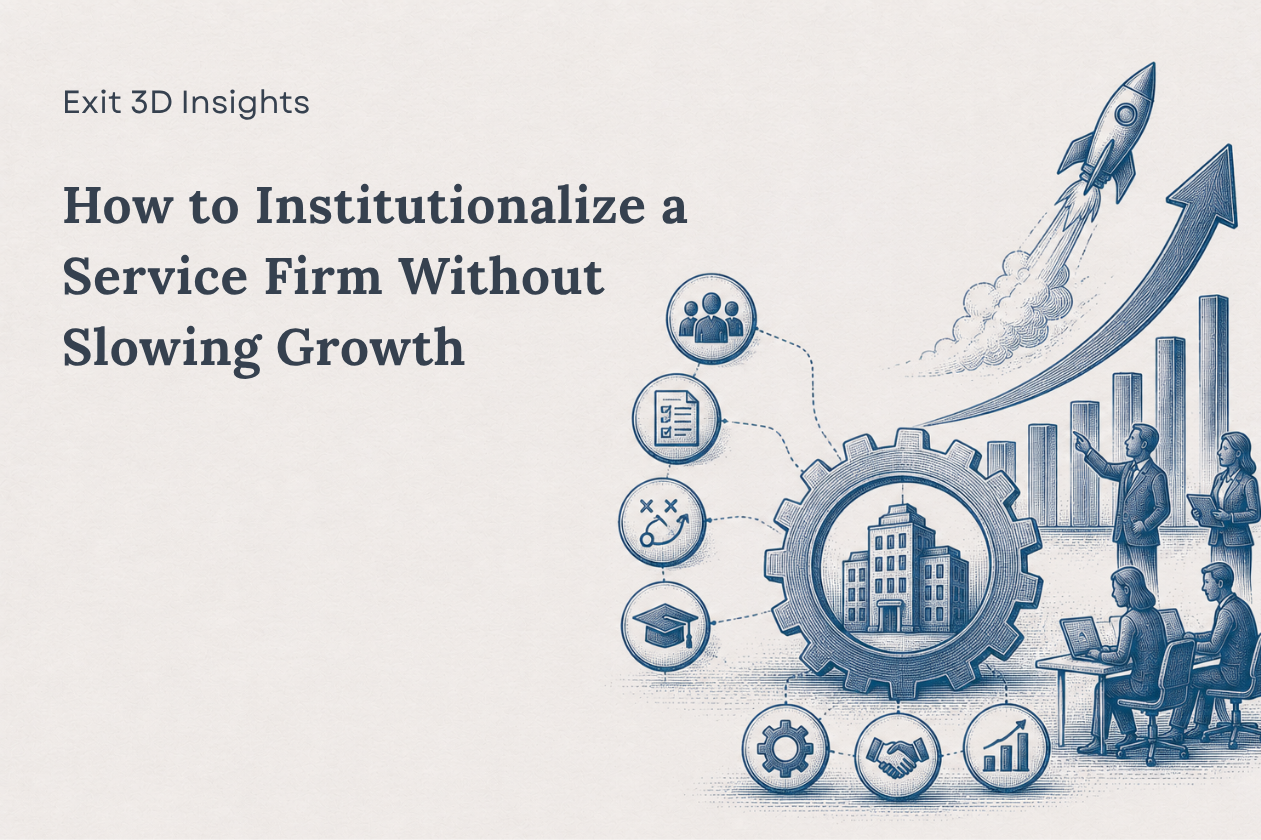
Most service firms stay founder-led because that feels faster. The problem is that speed often hides fragility, and fragility gets priced by buyers, lenders, and future operators. This post shows how to build a more institutional service business without flattening growth or turning the firm into a process-heavy machine. The objective is a company that can scale, transfer, and create more owner options.
A service firm that grew from $500K to $3M in four years can still be worth less than a $1.5M firm that built the right infrastructure. Revenue is not the variable buyers and lenders price. Continuity is.
Most founders treat institutionalization as something that happens later — after the next hire, after the next growth phase, after things slow down enough to document. That sequence is backwards. The firms that command premium valuations built repeatable operating structures while they were growing, not after.
The word itself puts founders off. Institutionalization sounds like bureaucracy, org charts, and slowed-down decision-making. It is not. It is the discipline of converting what you know how to do into something the business knows how to do — without you in every room.
This is not an exit-planning article. It is a growth article. Because the same structures that make a firm sellable are the structures that make it scalable, financeable, and capable of hiring people who can actually lead.
Most founders hear "institutionalization" and picture slower decisions, more approvals, and a firm that loses the agility that made it competitive. That is a misread of what the discipline actually demands.
Institutionalization means reducing single points of failure. It means the firm's delivery quality, client relationships, and financial controls do not depend on one person's memory, relationships, or daily presence. A firm with 12 employees can be fully institutionalized. A firm with 80 can still be a founder-dependent operation.
The question is not how many people you have — it is how many critical functions would stop working if you stepped away for 90 days.
In a product business, institutionalization is embedded in the product itself. In a service firm, the delivery mechanism is human — and usually founder-shaped. That is the core problem institutionalization solves.
It means three things in practice: repeatable execution, documented decision rights, and client relationships that belong to the firm rather than to an individual. None of these require a new management layer. All of them require deliberate design.
A service firm delivers through people. When those people operate from tribal knowledge and verbal instruction, the output varies with whoever is in the room. Repeatable execution means the process is defined clearly enough that a competent new hire can follow it without the founder translating it.
This is not about rigid scripts. It is about removing the part where performance depends on institutional memory that only exists in the founder's head.
Most founder-led firms have no explicit decision architecture. The founder decides everything above a certain complexity threshold, and that threshold is never written down. The result: growth stalls because every non-routine situation requires founder involvement.
Documented decision rights answer the question of who can authorize what — by role, not by person. They make the org chart functional rather than decorative.
When the client hired your firm because of you specifically, the contract value is partially personal. If you are unavailable, the relationship is at risk. Institutional client ownership means the firm has multiple touchpoints, documented account history, and a handoff protocol that does not depend on founder continuity.
A business becomes more valuable the moment decisions, delivery, and client relationships are no longer trapped inside one person.
A firm can double revenue in 18 months and still be fragile if the operating model is informal. Speed and scale amplify whatever is underneath — strong infrastructure scales well, weak infrastructure scales into chaos.
Founders who grow fast often mistake revenue momentum for business strength. When a lender or acquirer looks beneath the revenue line, what they find is whether the infrastructure kept pace with the growth. Usually it did not.
Fast growth on a fragile operating model does not create value — it creates a larger version of the same risk.
Growth creates its own camouflage. When revenue is climbing and clients are renewing, it is hard to see that the operating model is not keeping pace. The fragility is invisible until something breaks.
The break usually comes in one of three forms: a key person leaves, a major client escalates, or the founder tries to step back and nothing works the way it should. At that point, the gaps are obvious. Before that point, they are structural risks hiding behind strong topline numbers.
Informal operating models work when the firm is small enough that the founder touches every client engagement, every delivery decision, every hire. As the firm grows, the informal model does not scale — it just accumulates more dependencies on the founder's direct involvement.
Each new client, each new service line, each new team member added into an informal system increases the complexity the founder has to personally manage. At some point that system fails. It is not a leadership problem. It is an architecture problem.
When client relationships, delivery oversight, and financial approvals all route through the founder, the firm's growth ceiling is the founder's available hours. This is the most common reason service firms plateau between $1M and $3M — not market conditions, not talent, but the fact that the founder has become the constraint.
Lenders see this clearly in financial documentation. Buyers see it in customer dependency data and org chart interviews. Both price it as risk.
The firm that looks like it has momentum from the outside can look like a single-person operation from the inside of a diligence process.
When a lender underwrites a service business or a buyer runs diligence, they are not evaluating how impressive the growth story is. They are testing a single question: can this business continue producing without the person telling us about it?
Buyers and lenders reward continuity, not ambition. The proof they want is operational — documented processes, a leadership layer that can handle normal business complexity, client relationships with institutional depth, and financial controls that run independently.
Ambition gets you revenue. Continuity gets you a premium valuation and a financeable deal structure.
Buyers do not assume the founder will stay. Even in deals where the founder stays for a transition period, the acquisition price reflects what the business is worth without permanent founder dependence. That means specific operating functions must be demonstrably self-sustaining.
Delivery quality must hold without the founder in the production chain. Buyers will test this by reviewing client tenure, satisfaction signals, and whether the team can describe the delivery process independently. If the honest answer is "the founder reviews everything before it goes out," that is a concentration risk, not a quality system.
Every key account needs more than one institutional touchpoint. If the primary client contact calls the founder directly for anything of substance, the account is founder-dependent. Buyers model churn risk based on this exposure — and they discount accordingly.
New revenue generation that depends entirely on the founder's network and relationships does not transfer. Buyers want to see a pipeline with documented stages, lead sources that are not exclusively personal, and at least one other person who can close.
Monthly reporting, cash flow visibility, and billing controls must operate without founder intervention. A firm where the founder is also the de facto CFO presents a controls risk that affects both financing eligibility and deal structure.
Every function that runs only because the founder is present is a function that gets discounted at the valuation table.
Adding headcount without defining decision rights creates a more expensive version of the same founder-dependent firm. New hires slot into the existing informal hierarchy and learn to route everything through the founder — because that is how the firm operates.
Decision rights must come first. Define who can authorize what — by role, by scope, by dollar threshold — before you hire the person who will hold that authority. That sequence produces a leadership layer. The reverse produces a team that needs managing.
Structure enables delegation. Without it, headcount just adds cost without reducing founder dependency.
The instinct when a firm is overloaded is to hire. Hiring into an undefined structure does not reduce founder load — it redistributes tasks while keeping every decision above a certain complexity routed to the founder. The problem stays the same at a higher cost base.
Decision rights are a design problem, not an HR problem. They have to be built before the hire, not after.
Define what delivery decisions can be made by a project lead without escalation, what requires a senior review, and what requires founder input. Most firms have never written this down. The result is that every unusual situation becomes a founder call.
Once those thresholds are documented, the person you hire into a senior delivery role can actually operate independently. Without the documentation, you are hiring someone to watch you make decisions.
Client escalation protocols are one of the highest-leverage places to build decision rights. Define who handles a scope dispute, who handles a dissatisfied client, and under what conditions the founder gets involved. This protects client relationships and protects founder time.
If the answer to every client problem is still "get the founder," the firm has not built a client management layer — it has built a founder-dependency loop.
Define dollar thresholds and role-level authorities for hiring approvals, contractor engagements, and vendor spend. A team lead who cannot approve a $3,000 vendor contract without founder sign-off is not empowered to run their function. The firm is paying for a title without giving the authority the title implies.
Decision rights documentation is the foundation layer. Middle management only works if the authority structure exists for them to operate within.
Middle management in a service firm is not overhead. It is the mechanism by which founder judgment becomes repeatable execution. Without a layer that translates strategic intent into day-to-day delivery standards, the founder either manages everything directly or nothing gets managed at the right level.
The right middle management hire is not someone who relays the founder's instructions. It is someone who understands the delivery and client standards well enough to make judgment calls independently — and who has the documented authority to do so.
Middle management matters when it reduces the number of decisions that require the founder's direct input, not when it adds reporting structure.
Key-person exposure is one of the most common reasons service firms get discounted in financing and acquisition contexts. It means the business has a single point of failure — and that point is usually the founder.
Middle management solves this when it is built correctly. Incorrectly, it just adds a layer between the founder and the team without actually distributing authority or accountability.
An effective middle manager in a service firm runs a function — delivery, client success, business development — with enough authority to make normal operating decisions without escalation. They own outcomes, not just tasks. The distinction matters because outcome ownership is what creates genuine risk distribution.
When a buyer or lender models key-person risk, they look at what happens if the founder is unavailable for 30, 60, or 90 days. A middle management layer that owns outcomes changes that answer materially.
Most founders wait too long to build this layer. They promote operationally strong people into management roles without defining what managing means in their firm. Those people succeed at tasks but fail at leadership — not because they lack capability, but because the decision rights and scope were never defined.
Build the role architecture first. Then hire or promote into it.
A firm with a functional middle management layer can take on more clients, enter new service lines, and hire more quickly because the founder is not the integration point for every new piece. That is not an exit-readiness metric. It is a growth capacity metric.
The firms that scale past $5M without breaking are almost always the ones that built a real management layer at $2M, not at $4M.
The concern founders have about building systems is usually that systems slow things down. The right systems do the opposite: they reduce the amount of founder intervention required to maintain quality, which accelerates the firm's ability to grow and hire.
Transferability is not about documentation for its own sake. It is about making performance less dependent on memory, heroics, and proximity to the founder. A project management system that defines delivery milestones removes the need for a founder check-in. A client onboarding protocol that is documented removes the need for the founder to walk every new account through it personally.
The right systems reduce founder dependency at the point of delivery — and that reduction is exactly what buyers and lenders price as transferable value.
Not all systems are equal. Some documentation creates process theater — checklists nobody uses, SOPs nobody reads, meeting structures that consume time without improving outcomes. The systems worth building are the ones that change what happens at the moment of delivery.
A delivery framework is not a long document. It is a defined sequence of steps, owners, and quality checkpoints that any competent person can follow. It converts the founder's intuition about what a good engagement looks like into something a senior hire can execute independently.
The test for a good delivery framework: give it to a strong hire who has never worked with you, and see whether the client output meets your standard. If it does not, the framework needs work. If it does, you have built transferable delivery.
Onboarding is where client relationships are formed. A documented onboarding protocol ensures every client gets the same quality of first experience, regardless of who runs the engagement. It also protects client relationships from individual staff turnover — because the relationship is recorded, not just remembered.
Monthly P&L, cash flow forecasting, and accounts receivable aging should run on a defined schedule without founder involvement in the production of the reports. Founders who produce their own financial reports are a controls risk. The data exists, but the oversight layer does not.
A pipeline that exists only in the founder's head or email is not a pipeline. It is personal knowledge. A documented CRM with deal stages, owner assignment, and close probability makes the revenue forecast reviewable, auditable, and transferable.
Systems that replace founder memory with institutional record are the highest-leverage transferability investments a service firm can make.
The belief that institutional structure and growth speed are in opposition is one of the most expensive assumptions a service founder can hold. Firms that stay deliberately lean in their operating model are not protecting agility — they are protecting founder indispensability.
A business that runs on defined principles, documented controls, and distributed authority creates more strategic options than one that runs on founder proximity. It can hire better people because roles are defined. It can take on more growth because the founder is not the constraint. It can attract better financing because lenders can model continuity.
A business that runs on principles and controls rather than proximity to the owner is not slower — it is more capable of compounding.
Institution-grade is not a certification. It is a functional threshold — the point at which the firm can operate, grow, and handle complexity without the founder being the answer to every hard question.
There are clear signals. Delivery runs to the same quality standard whether or not the founder reviewed the output. Client escalations get resolved by a team member with the authority to resolve them. New business gets closed by someone other than the founder at least some of the time. Financial reporting runs on schedule and the founder reads it rather than produces it.
These are not aspirational targets. They are observable behaviors. If you cannot point to examples of each happening in the last 90 days, the firm is still founder-dependent in those functions.
The financing signal is also concrete. If you applied for a growth credit facility today, what makes a company financeable is exactly this — lenders want to see operating continuity that does not depend on the borrower's daily presence. A firm that cannot demonstrate that will get a smaller facility, a higher rate, or a declined application.
The same logic applies if you are considering a growth equity partner or a future sale. As covered in the analysis of building an option-ready service business, the structural moves that preserve your options are the same ones that accelerate your growth capacity — they are not two separate work streams.
And for founders thinking specifically about how middle management changes valuation, the evidence is consistent: the firms that built the leadership layer early commanded better multiples because buyers could underwrite continuity, not just growth trajectory.
The goal is not a firm that looks institutional in a pitch deck. It is a firm that behaves institutional in the places that determine whether it can survive, scale, and attract capital on its own terms.
Institutionalization is a value-building discipline. The service firms that attract the best financing terms, the most capable hires, and the strongest acquisition interest are not the ones with the highest revenue — they are the ones where delivery, decisions, and client relationships have been removed from single-point-of-failure dependency on the founder. The mechanism is not complexity. It is intentional design.
A service firm becomes more valuable when it behaves like an institution in the places that matter and stays lean everywhere else.
If you stepped away from your firm for 60 days with no ability to make decisions or take calls, which functions would hold and which would break?
If most functions would hold, you have built something. If the honest answer is that delivery quality, client relationships, and new revenue would all degrade within weeks, you do not have a people problem or a growth problem — you have an architecture problem. The fix is not hiring more. It is designing the operating structure that makes your current team capable of running the firm at its current standard without you in the room.
A firm that needs the founder present to perform at its current level is not growing — it is cycling through the same fragility at higher revenue.

%20(1)%201.webp)

.png)
.png)

.webp)

.svg)
.svg)
.svg)