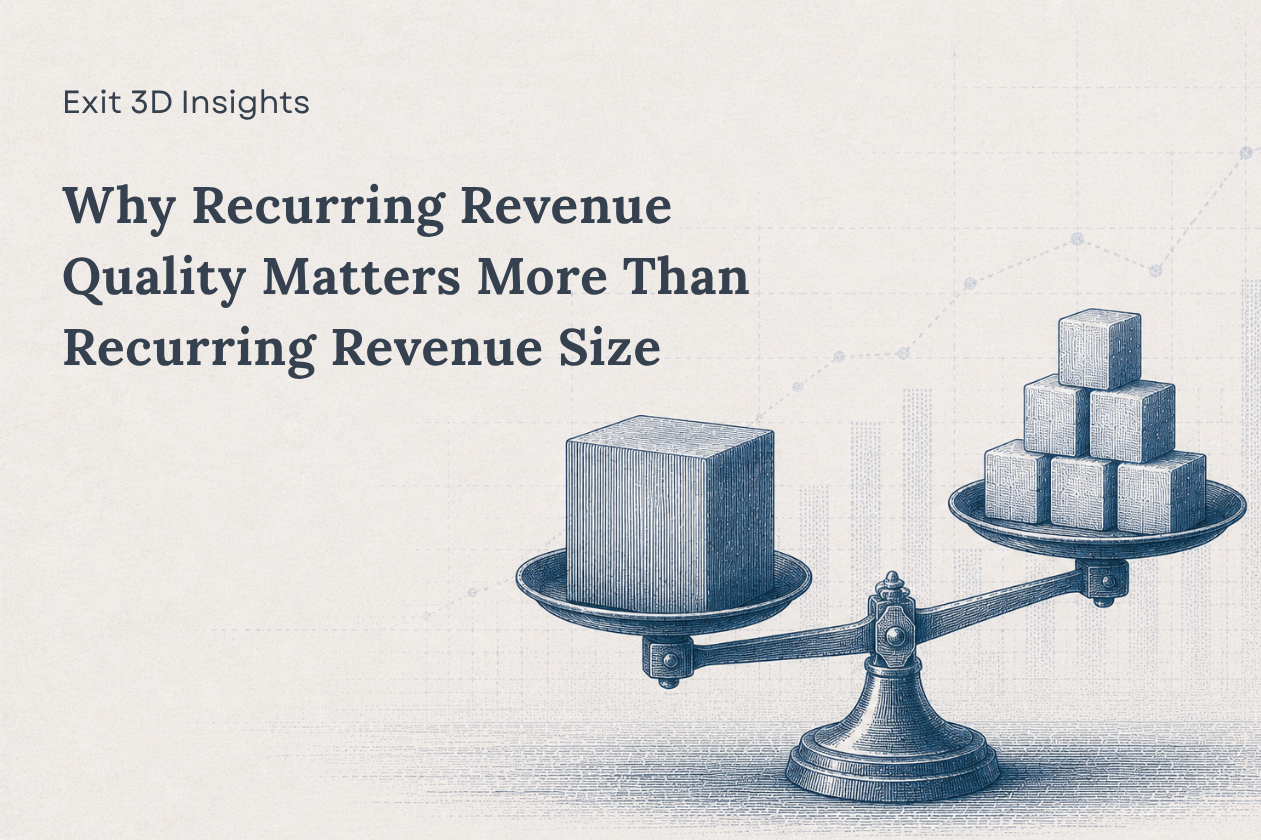
Two service businesses. Same EBITDA, same revenue size, both with recurring revenue lines. One closes at 4.5× EBITDA. The other closes at 2.1×. The difference isn't growth rate or client count — it's whether the buyer can trust that next year's revenue lands without the founder working for it.
Recurring revenue is the most misunderstood lever in service business valuation. Founders treat the label as a premium. Buyers treat it as a hypothesis — one they spend weeks trying to disprove.
The question isn't whether your revenue repeats. The question is why it repeats, and what happens to renewal rates if you step back, raise prices, or change the delivery model.
Most founders never test their own revenue this way. Buyers do it before they sign a letter of intent. What they find often reframes the entire deal.
Buyers distinguish between contractual repetition and actual retention. Revenue that renews on paper is not the same as revenue that renews because clients have no reason to leave.
A retainer structure, a monthly fee, an annual contract — these are delivery mechanisms, not evidence of stickiness. Buyers look underneath the label to find churn rates, renewal triggers, and what happens at year two and three when the novelty of a new vendor wears off.
The label 'recurring' gets a business in the room. The quality of that revenue determines the multiple.
When a buyer asks about your recurring revenue, they are not asking how much of your revenue is on retainer. They are asking how much of next year's revenue is already locked in, at what price, under what terms, and without requiring your personal involvement to retain.
That is a fundamentally different question. Most founders answer the first one and assume they've answered the second.
Repetition means a client paid you this year and last year. Reliability means a buyer can model that client paying again next year, at the same price, under the same terms, without needing the current owner to manage the relationship.
A client who renews annually because they trust you personally is repetition. A client who renews because your software is embedded in their operations, or because switching costs are high, or because your contract auto-renews with a 90-day notice window — that is reliability.
Buyers model cash flow. They are not buying your past. They are pricing their confidence in your future, and they apply a discount wherever confidence is thin.
In diligence, buyers will pull your last three years of revenue by client, map renewal dates, and calculate net revenue retention — the percentage of last year's recurring revenue that came back this year, plus any expansions.
Net revenue retention above 100% signals that existing clients are growing with you. Below 90% signals churn risk. A number that looks fine on average can hide severe concentration risk when you map it client by client.
What a buyer is really asking is: if I remove the founder on day one, does this revenue still renew?
A large recurring base creates comfort for founders who built it. It does not automatically create confidence for buyers who are underwriting it. The discount comes when the renewals depend on founder relationships, custom delivery, or informal agreements that don't survive a transition.
Buyers consistently apply haircuts to recurring revenue that renews through relationship rather than structure. If your five largest clients renew every year because they like working with you personally, a buyer prices that as an earnout risk, not a stable cash flow stream.
Size without structure is not an asset — it is a liability dressed as one.
Contracted revenue means a client signed an agreement to pay you. Retained revenue means a client chose to keep paying you when they had the option to leave. These measure different things, and buyers weigh them differently.
A 12-month contract with a 30-day cancellation clause is not 12 months of locked revenue. It is 30 days of locked revenue, renewable on short notice, eleven more times. Buyers read contracts before they trust your revenue model.
The specific terms inside a contract determine how much revenue protection it actually provides. Cancellation windows, auto-renewal mechanics, pricing escalation clauses, and scope change provisions all tell buyers how hard it is to lose a client — and how hard it is to keep a client at the same margin.
A contract that requires the client to give 90 days notice to cancel, with an automatic annual price increase, is a fundamentally different asset than a month-to-month retainer billed on good faith. Both might be described as
Short renewal cycles, cancellation rights, and price sensitivity can make recurring revenue less financeable than one-time project revenue. A project with a signed statement of work and milestone billing is often easier to underwrite than a retainer that technically renews annually but has never been tested with a price increase.
When lenders and acquirers assess serviceability, they are looking for cash flows that are durable and predictable without operational heroics. Contracts that survive transitions, resist easy cancellation, and include escalators are the ones that support higher multiples and cleaner financing.
Short cancellation windows don't just reduce contract value — they reduce the entire business's financeability.
Buyers and their lenders do not take your recurring revenue number at face value. They apply a set of underwriting tests designed to stress the revenue under conditions that resemble a post-acquisition environment. Most founders have never run these tests on themselves.
Would these clients renew if the founder exited on closing day? This is the most important question a buyer asks about recurring revenue. If the answer is uncertain for your top five clients, you will see that uncertainty reflected in price, deal structure, or both.
Buyers often solve transition risk through earnout provisions or seller notes — requiring the founder to stay and proving that revenue holds before releasing full payment. If you want a clean exit, you need to prove transition stability before the offer is written.
When did you last raise prices on your recurring clients? If your pricing has been flat for three or more years, a buyer sees a revenue line that depends on below-market rates to stay. That is not stability — it is deferred churn.
Buyers want to know that your recurring revenue survives a 10 to 15 percent price normalization. If it doesn't, the revenue is more fragile than the headline number suggests.
If your top three recurring clients represent more than 40 percent of your recurring revenue, buyers apply a concentration discount. The math is simple: lose one of those clients post-close, and the revenue profile changes materially. Lenders may not finance against that risk at all.
Every underwriting test is asking the same question: what happens to this revenue when conditions change?
Lenders and acquirers look for evidence that next year's cash flow is predictable without intervention. They are not underwriting your relationships — they are underwriting the structure that produces revenue regardless of who is managing it.
This distinction matters because lenders, especially SBA lenders, will only advance against revenue they believe will persist through a leadership change. If your renewal rates drop sharply when modeled without founder involvement, the lender will reduce the loan amount, which reduces what a buyer can offer.
Financing capacity determines offer price — and financing capacity is determined by revenue quality, not revenue size.
Revenue fragility is rarely intentional. It accumulates through decisions that looked like good client service at the time — flexibility on pricing, informal renewals, customized delivery, founder-led relationships. Each one individually seems harmless. Together they create a recurring revenue base that doesn't hold up under scrutiny.
Offering clients flexible month-to-month arrangements feels like a retention strategy. It reduces friction and keeps clients happy in the short term. But it also means your revenue can disappear in 30 days, at any point, for any reason.
Buyers see month-to-month recurring revenue and immediately model a faster churn scenario. The revenue gets a lower quality score even if no client has ever left, because the option to leave is always open.
When your recurring service is highly customized per client, delivery depends on specific people — often the founder or a senior employee. That makes the service hard to transition, hard to scale, and hard to price consistently.
Buyers will ask how delivery works on your top ten recurring clients. If the answer involves bespoke processes, custom outputs, or named individuals who manage the relationship, the revenue gets discounted for operational dependency.
Some recurring relationships exist without formal contracts at all — just a standing invoice and an unspoken understanding. These relationships work fine as long as the founder is present and the client is happy. They create a problem the moment either condition changes.
The most common source of recurring revenue risk isn't aggressive clients — it's informal structures the founder never formalized because they seemed unnecessary.
Standardized, sticky, diversified, and easy to transition — these are not exciting characteristics, but they are exactly what buyers price at a premium. Revenue that requires creativity, customization, or founder presence to renew carries implicit risk that suppresses the multiple.
Think about the service your business could deliver consistently at scale, without you, to clients who have a strong operational reason to stay. That profile — not growth rate, not innovation — is what commands a 4× to 6× EBITDA multiple in a service business sale.
Boring recurring revenue is premium recurring revenue.
The way you deliver your service has a direct effect on how buyers model renewal risk. Delivery model is not just an operational question — it is a valuation input. Buyers assess whether your service can be delivered consistently after you leave, at the same quality, to the same clients, without renegotiation.
Systematized delivery means the output is defined, the process is documented, and the quality doesn't depend on who runs the account. A new hire following your playbook should be able to produce the same result. That is what makes the service transferable.
Founder-shaped delivery means the quality and relationship depend on your judgment, your relationships, or your creative input. Clients may not even know there's a formal process — they just trust you. That trust doesn't transfer in an acquisition.
If different clients pay materially different prices for the same recurring service, buyers see three possible explanations: the service isn't standardized, pricing is negotiated by relationship, or clients are underpriced relative to what the market will bear.
All three explanations create friction. Inconsistent pricing signals that the revenue model is informal, which means future pricing is unpredictable — which means the buyer can't trust the margin they're buying.
Delivery consistency and pricing consistency are two sides of the same value signal.
A buyer will often pay more for lower but cleaner recurring revenue than for higher revenue with hidden re-sale risk. This is a counterintuitive but consistent pattern in service business acquisitions. The buyer is not maximizing revenue — they are minimizing uncertainty.
Clean recurring revenue means: auto-renewing contracts, consistent delivery, no single client above 20 percent, price increases absorbed without attrition, and no founder involvement required at renewal. A business with $800K of that kind of recurring revenue often prices higher than a business with $1.5M of recurring revenue that depends on the founder's relationships.
Quality of recurring revenue is not a refinement of valuation — it is the primary driver of it.
Most founders think about recurring revenue quality as a buyer concern. It is equally a lender concern — and lenders often have more influence over your final deal terms than the buyer does.
When a buyer uses SBA financing or bank debt to fund an acquisition, the lender underwrites the business independently. They are not financing the buyer's optimism. They are financing their own risk assessment of whether the business can service the debt.
Lenders calculate debt service coverage ratios based on projected cash flow. If a significant portion of your revenue is recurring but structurally fragile, the lender will apply a stress scenario: what if 20 percent of that recurring revenue doesn't renew in year one post-close?
If the business can't service its debt in that scenario, the lender reduces the loan amount. A reduced loan amount means the buyer can offer less. The seller absorbs the gap through a lower price, a seller note, or both.
Lenders who are uncomfortable with revenue durability will require the seller to carry a note or accept a deferred payment structure. This is not a negotiation outcome — it is a financing requirement. The seller ends up with more risk in the deal specifically because the revenue profile didn't hold up to lender underwriting.
Recurring revenue that a lender can't underwrite becomes a deal structure problem the founder pays for.
Most founders treat recurring revenue quality as an operating metric — something that improves service delivery or client satisfaction. In the context of exit, it is a valuation strategy. Every structural improvement to your renewal mechanics, contract terms, and delivery model is directly translatable into a higher multiple and a cleaner deal.
The work done 12 to 24 months before a sale — formalizing contracts, removing founder dependency from renewals, tightening cancellation windows, diversifying the client base — is the work that moves a business from a 2× to a 4× exit. It is not preparation. It is value creation.
The founder who improves recurring revenue quality before selling isn't getting ready for exit — they're already executing one.
The structural improvements that most affect recurring revenue quality are achievable in 12 to 24 months if you start with a clear view of where the fragility sits. The work is operational, but the payoff is financial.
Start with contracts. Every recurring client should have a written agreement that specifies the scope, the price, the renewal terms, and the cancellation window. Month-to-month arrangements should be converted to annual agreements with auto-renewal and 60 to 90 day cancellation notice requirements.
If you want a sense of how buyers read your existing contracts, the contract structure and termination risk framework is worth understanding before diligence begins.
Map every recurring client and identify who owns the renewal relationship. If that person is you, build a transition plan. Assign account managers, document the relationship history, and begin the handoff at least 12 months before a planned sale.
Buyer confidence in founder dependency and its valuation impact is worth quantifying before you enter a process — the discount for founder-dependent revenue is real and measurable.
Audit your recurring revenue for pricing outliers — clients paying significantly below your current rate. Either bring them to market pricing before the sale or be prepared to explain the gap to a buyer. Flat pricing for three or more years is a red flag in diligence.
Run a price increase test 18 months out. Clients who absorb a 10 to 15 percent increase without attrition are proof that your recurring revenue is durable. That proof is worth more in a buyer conversation than any marketing narrative.
If your top three recurring clients represent more than 40 percent of your recurring revenue, client concentration risk and its effect on your multiple will surface in every offer you receive. Prioritize new client acquisition in the 12 to 24 month window specifically to reduce that concentration.
The 24 months before a sale are the highest-leverage period you have to change what a buyer sees when they look at your revenue.
Recurring revenue only increases business valuation when it is structured to survive without the founder, documented in enforceable contracts, and diversified enough that no single client exit changes the model materially. Buyers and lenders both underwrite the structure, not the label — and they discount anything that depends on relationship, customization, or informal renewal to persist.
The difference between a 2× exit and a 4× exit is often not revenue size — it is whether the recurring revenue holds up when the founder walks out the door.
If you stepped away from your business today, what percentage of your recurring revenue would renew next year without your direct involvement?
If the honest answer is below 80 percent, the structure of your exit is already written — it just isn't written in your favor. A good answer means your revenue is systematized, your contracts are formal, and your delivery doesn't require you. A number below 80 percent means a buyer will build in the risk through price, structure, or both.
Recurring revenue is not what you've built — it's what survives after you leave.

%20(1)%201.webp)

.png)
.png)

.webp)

.svg)
.svg)
.svg)