Most service businesses grow through founder effort, not company assets. That creates fragile revenue, weak transferability, and limited valuation upside. The better test is whether growth can continue when the founder is less central to sales, delivery, and client retention.
Most service business founders measure progress by revenue. A better measure is how much of that revenue survives without them. If you stepped back for 90 days, what breaks first — the delivery, the sales, or the relationships holding the whole thing together?
The honest answer for most founders is: all three. And that is not a hustle problem. It is a structure problem.
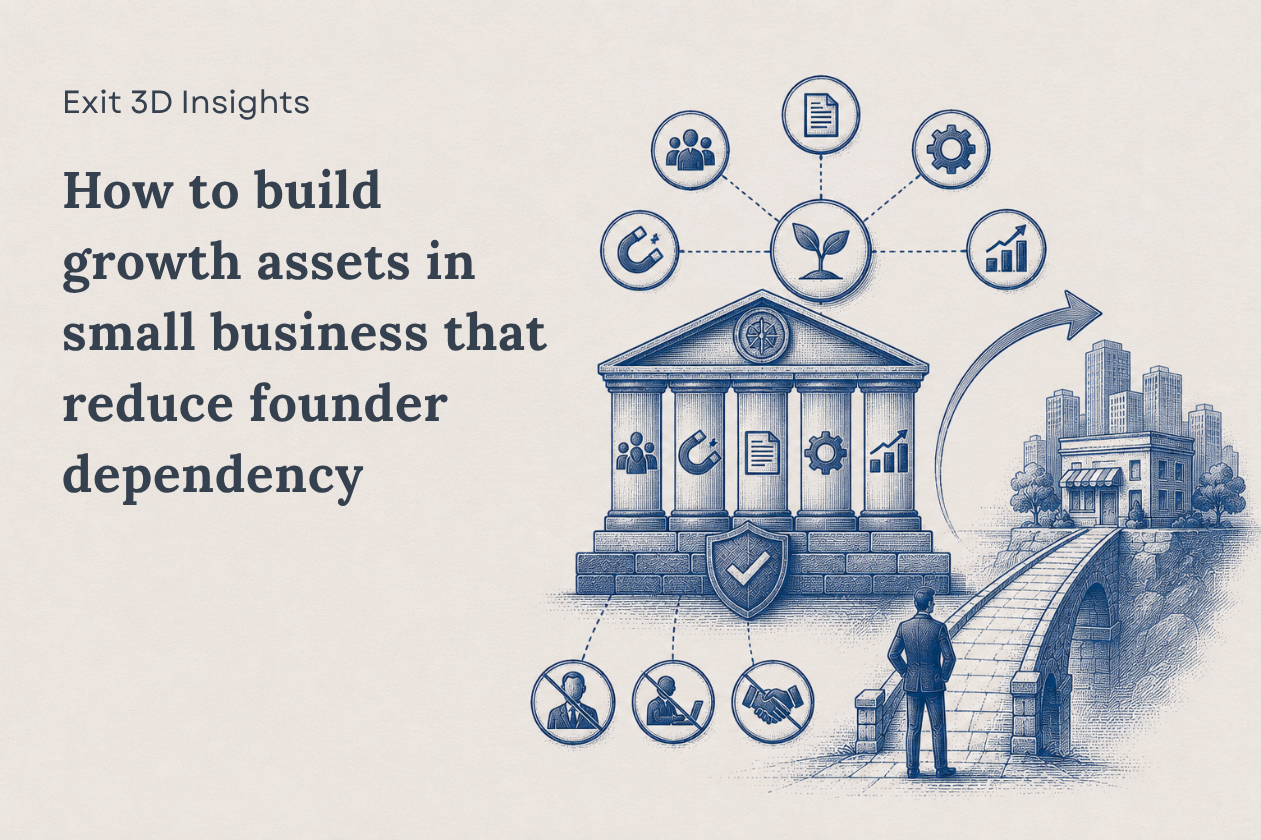
Building growth assets in small business is not about working more or hiring faster. It is about converting the things you personally do into things the business owns. Systems, documented processes, owned channels, and structured relationships. Those are the four categories that determine whether growth is transferable or just temporary.
Buyers, lenders, and even your own future self evaluate the same question: can this business keep growing if the founder is no longer the engine? When the answer is no, you are not building a business. You are building a job with overhead.
A growth asset is not a skill, a relationship, or a reputation that lives in the founder's head. It is something the business can access, repeat, and deploy independently of who is in the operator seat. Think: a documented sales process, an SEO-driven content channel, a referral system with defined triggers, or a client onboarding sequence that runs without daily intervention.
The distinction matters because buyers and lenders underwrite what the business owns, not what the founder does. A founder who is brilliant at closing enterprise deals has not built a growth asset — they have built a dependency. A business with a structured pipeline and repeatable qualification criteria has built something that survives the transition.
A growth asset is something the business owns, not something the founder personally produces.
The word "asset" in most small business conversations means equipment, real estate, or cash. In a service business, those categories are largely irrelevant. The real assets are operational and structural — and most founders have never been asked to name them.
A growth asset is any mechanism that generates revenue, referrals, or retained clients without requiring the founder's direct intervention to function. It is owned by the business, documented in the business, and reproducible by someone other than the person who created it.
Effort produces revenue. Ownership produces value. The two are not the same. A founder who personally closes every deal produces revenue through effort. A business with a defined sales process, trained closers, and a documented qualification framework produces revenue through ownership.
The effort disappears when the founder does. The ownership stays. That gap is what buyers are pricing when they discount founder-led service firms at 1–2× EBITDA instead of 4–6×.
In practical terms, growth assets in a service business fall into four types: systems (repeatable processes that run without daily oversight), channels (owned or structured sources of inbound demand), documentation (the conversion of tribal knowledge into transferable operating guides), and relationships (structured client and referral relationships with terms, not just goodwill).
None of these require massive infrastructure. A single well-documented referral protocol, consistently executed, is a growth asset. An informal relationship where clients come to you because they like you personally is not.
If it only works because you show up, it is not yet an asset.
When revenue requires the founder's memory, network, or daily intervention to function, the business has not built growth — it has built fragility. Every dollar tied to the founder's personal involvement is a dollar a buyer or lender has to discount, because it disappears the moment the operator changes.
This is not a productivity issue. It is a structural issue. A founder who works 60 hours a week is not necessarily building founder dependency — but a founder whose clients only renew because they personally follow up, whose referrals only come because of informal relationships, and whose pipeline only fills when they are actively networking is building exactly that.
If revenue depends on the founder's memory, network, or daily intervention, it is not yet an asset.
Growth that runs through the founder feels like momentum. From the outside — from a buyer's, lender's, or even a senior hire's perspective — it looks like concentration risk.
Every dollar of revenue that exists because the founder is personally managing the relationship, personally driving the referral, or personally closing the deal is a dollar that is priced with a discount. Not because it is not real revenue. Because it is not durable revenue.
When a lender underwrites a service business for acquisition financing, one of the first questions is: does this business perform if the seller exits on day one? If the answer requires material caveats — the founder needs to stay for 18 months, key clients are personal relationships, the pipeline is relationship-driven without a documented process — the lender either reprices the risk or walks.
SBA lenders in particular scrutinize this. A business that cannot be transferred without the founder's ongoing involvement creates a collateral risk the lender cannot absorb.
Buyers are not just evaluating whether the business is profitable. They are evaluating whether the business is operable after the transaction. Will the clients stay? Will the referral sources stay? Will the team perform without the founder's daily presence? These are not soft questions. They show up in deal structure — in earn-outs, seller notes, and escrow holdbacks that transfer risk back to the seller.
A business with documented systems, owned channels, and structured relationships answers those questions before they are asked. A founder-dependent business answers them badly, every time, in every deal room.
Founder-driven growth does not compound. It resets every time the founder steps back.
When growth depends on the founder's personal execution, buyers and lenders apply a structural discount to the earnings they are willing to underwrite. It is not a soft concern about culture or leadership — it is a financial calculation about repeatability. Revenue that cannot be replicated without the original operator is priced as a runoff risk, not a going-concern value.
This discount shows up at the multiple level. Two businesses with identical EBITDA will receive materially different offers if one has a documented, system-driven growth engine and the other runs entirely through founder relationships and personal follow-up.
Buyers and lenders discount growth that cannot be repeated without the original operator.
Buyers do not trust narrative. They trust mechanisms. When evaluating a service business, they are looking for evidence that growth can continue after the transaction — and that evidence comes in four specific categories.
A system is a repeatable process with defined inputs, steps, and outputs that does not require the founder to initiate or supervise. Sales systems, onboarding systems, service delivery workflows, renewal processes — these are the operational backbone of a transferable business.
The test for a system is simple: can a competent hire execute it without asking the founder how? If the answer is no, you have a process in someone's head, not a system in the business.
Owned channels are demand sources the business controls without relying on founder relationships or personal outreach. SEO-driven content, structured referral programs with defined mechanics, strategic partnerships with documented terms — these are channels. A founder's personal LinkedIn following is not.
The best channels widen the sources of demand. The best growth assets lower customer concentration by widening the sources of demand. A business that generates inbound from three independent channels is structurally safer — and more financeable — than one that depends on the founder's network for 80% of new business.
Documentation converts what the founder knows into what the business owns. Service delivery playbooks, client communication templates, escalation protocols, onboarding checklists — these transform tribal knowledge into transferable operating capability.
Most founders underestimate documentation because it does not feel like growth work. Buyers price it as a risk reducer, which means it directly affects the multiple they are willing to pay. A business with strong documentation is not just easier to transfer — it is faster to finance, because the lender can underwrite the operations, not just the earnings.
Structured relationships are different from personal ones. A client relationship that is documented, governed by contract terms, and serviced by a team is a business asset. A client relationship that exists because the founder plays golf with the CEO is a personal asset — and it does not transfer.
The same logic applies to referral sources and strategic partners. If the relationship lives in the founder's phone, it is a liability at exit. If it is documented, managed through a defined touchpoint cadence, and supported by an account manager, it is an asset.
Most of what a founder knows about running their business is not written down anywhere. How to handle a difficult client conversation, how to price an unusual engagement, how to manage a key vendor relationship — these live in the founder's memory and instinct. That is fine for daily operations. It is a problem for transferability.
Documentation does not mean bureaucracy. It means capturing the decisions, protocols, and judgment calls that make the business run, in a format that a competent operator can access and execute. A 5-page delivery playbook is more valuable at a transaction than 5 years of the founder being good at their job.
Documentation matters because it converts tribal knowledge into transferable operating capability.
The fastest diagnostic is a removal test. Ask yourself: which parts of our growth engine stop working if I personally stop executing them? If the list is long, your growth engine is a liability, regardless of how strong your revenue looks today.
Walk through every source of new business in the last 12 months. For each one, ask: did this happen because of a system, a channel, or a documented process? Or did it happen because I personally made a call, attended an event, or leveraged a relationship?
If the majority of new revenue traces back to founder actions rather than business mechanisms, the growth engine is founder-dependent. That dependency is not reflected in your P&L — but it is reflected in how a buyer prices your risk.
Inbound leads arrive through channels you do not personally manage. Proposals go out through a process your team runs. Clients renew because the service delivery and relationship management systems work — not because you personally followed up. Referral sources send business reliably, through a structured program, not because they like you.
These are signals of an asset. They are also signals that the business could operate, grow, and generate new clients without the founder in the seat. That is what option-ready looks like.
You are the first point of contact for new opportunities. You personally close the majority of deals. Your top clients call your cell, not the company line. Your referral sources are your personal contacts. Your pipeline visibility depends on your memory of recent conversations.
None of these make you a bad founder. They make you an irreplaceable one — and irreplaceable is not a compliment in a deal room.
A growth engine built around the founder's personal relationships, memory, and daily follow-up creates revenue but not value. The distinction is precise: revenue is what the income statement shows. Value is what survives a change in operator. If those two numbers diverge significantly, the business has a structural problem, not a performance problem.
The practical test is repeatability. Can the same growth mechanism produce similar results next quarter with a different person executing it? If the answer requires significant caveats — the new person would need the founder's relationships, instincts, or informal knowledge — then the mechanism is not yet an asset.
Buyers and lenders do not pay for revenue that resets when the founder steps back.
Most service business founders work hard. The failure is rarely effort. The failure is that effort never gets converted into something the business owns and can repeat. Three patterns account for the majority of this gap.
Service founders often resist systematizing delivery because they believe their personal touch is what clients pay for. Sometimes that is true. More often, clients pay for outcomes — and outcomes can be systematized without losing quality.
The cost of personalized delivery without process is invisible during growth. It becomes visible when you try to scale, hire, or exit. Every new client requires founder involvement because there is no playbook. Every departure is a service risk because the delivery lives in the founder's execution.
Relationship selling works. The problem is that it does not transfer. When a founder's personal network is the pipeline, the pipeline is not a business asset — it is a personal one. And personal assets do not appear on a buyer's balance sheet.
The fix is not to stop relationship selling. It is to document the relationships, structure the follow-up cadence, and create a process that a sales hire can execute using the same approach. The relationship context becomes institutional. The effort becomes repeatable.
Attending conferences, posting on social media, sending newsletters — these are activities. They may generate leads. They are not growth assets unless they are attached to a system with defined conversion mechanics and measurable outcomes.
Activity that cannot be delegated, measured, and repeated at scale is not building anything the business owns.
Lenders underwriting a service business acquisition are not just looking at historical earnings. They are pricing the probability that those earnings continue after the transaction. A business with documented systems, owned channels, and structured relationships gives a lender a credible case for continuity. A founder-dependent business gives them a risk they have to discount — or decline.
This is why growth asset development is not just an exit strategy. It is a financing strategy. A business that can demonstrate repeatable, system-driven growth is more likely to qualify for SBA or conventional acquisition financing at favorable terms — because the future earnings are less speculative.
A business with growth assets is easier to finance because its future is less speculative.
The three outcomes — transferability, financing, and valuation — are not separate goals. They are downstream effects of the same structural work. Build the assets, and all three improve simultaneously.
A transferable business is one where the new operator can produce the same outcomes without the seller's ongoing involvement. That requires documented systems, structured relationships, and an owned growth channel that does not depend on the founder's personal credibility. Transferability is not a soft concept — it is the precondition for any deal to close cleanly.
Buyers who cannot underwrite transferability will either walk, restructure the deal with heavy earn-outs, or require a multi-year transition that erodes the seller's effective exit price. Growth assets eliminate those friction points before they reach the negotiation table.
SBA lenders, conventional lenders, and private equity all apply a version of the same test: will this business still perform after the transaction? A business with documented growth systems and owned channels answers that question with evidence. A founder-dependent business answers it with hope.
The practical effect is access. A business with strong growth assets qualifies for more financing structures, at higher leverage, with fewer founder-contingency requirements. That access directly affects buyer pool size — and buyer pool size directly affects price.
Service business valuation is driven by risk-adjusted earnings. The adjustment happens when buyers and lenders apply a discount for factors that make future earnings uncertain. Founder dependency is one of the largest discount drivers. Remove it — through systems, documentation, and owned channels — and the risk adjustment shrinks, which means the effective multiple expands.
The multiple is not a reward for performance. It is a function of how predictable the business looks without you in it.
Most founders accept a quiet trade-off: growth requires more of their personal time and energy. That trade-off feels normal. It is also the definition of a ceiling. A business that only grows when the founder does more work is not scaling — it is intensifying.
The alternative is a business where growth is driven by assets the company owns: channels that produce inbound without the founder's outreach, systems that convert and deliver without the founder's oversight, relationships that are institutionalized and managed by a team. That business can grow without the founder becoming more indispensable.
The goal is not just scale. It is creating a business that can grow without becoming more dependent on you.
If you are running a founder-dependent service business today and want to create more options — more financing access, more leverage in a future transaction, more ability to step back without revenue collapsing — the sequencing matters.
Start with the removal test. Identify the three or four growth activities that would fail immediately if you stopped executing them personally. Those are your highest-priority conversion targets: the places where you need to build a system, document a process, or structure a relationship before it can function without you.
Documentation is the fastest leverage point because it does not require hiring or infrastructure. A sales playbook, a client onboarding guide, and a service delivery checklist can be built in weeks. They immediately reduce founder dependency in the areas buyers and lenders scrutinize first.
Documentation also creates the foundation for delegation. You cannot delegate what is not documented. Once it is written, you can hire, train, and step back — in that order.
Pick one inbound channel and invest in making it owned: SEO-driven content, a structured referral program, a strategic partner relationship with defined mechanics. One channel that produces qualified leads without your personal outreach is worth more structurally than ten relationship-driven leads that trace back to your phone.
As you build that channel, measure it. Document the conversion rates, the lead sources, the client acquisition costs. Those numbers are what a buyer or lender will want to see — and having them on record creates credibility that informal activity never can.
Your most valuable client and referral relationships need to be transitioned from personal to institutional before any other growth strategy compounds. Assign account managers. Document the relationship history. Create a structured touchpoint cadence that runs without you initiating it.
If your top three clients would leave if you left, you have not built a client base — you have built a personal following. The work of institutionalizing those relationships is the most protective thing you can do for your valuation, your financing access, and your ability to step back on your own terms.
This is the architecture of a business that earns real options. For deeper context on what buyers specifically audit in these areas, it is worth understanding what makes a service business option-ready before a transaction is ever on the table. It is also worth understanding how founder dependency gets priced in a deal — because the discount is larger than most founders expect. And if your growth engine is still founder-driven, reviewing how buyers audit a growth engine will show you exactly what evidence they are looking for before they trust your numbers.
Building growth assets in small business is not about adding complexity — it is about converting what the founder personally does into what the business structurally owns. Systems, owned channels, documentation, and institutionalized relationships are the four mechanisms that make growth repeatable, transferable, and financeable. Every one of them reduces founder dependency, and every reduction in founder dependency expands the multiple a buyer or lender will apply.
The business that grows without you is not just more valuable — it gives you more choices, including the choice to stay.
If you stepped out of your business for six months, which parts of your growth engine would still be producing — and which parts would go quiet?
A strong answer names specific systems, channels, and team members who can execute without your involvement. A weak answer defaults to optimism: the team would figure it out, or clients would stay because of our reputation. Those answers are not wrong — they are just not evidence. And buyers, lenders, and even your future self need evidence, not reassurance.
The gap between what you believe would continue and what you can actually prove would continue is the exact size of your founder dependency problem.

%20(1)%201.webp)

.png)
.png)
.webp)

.svg)
.svg)
.svg)